NEXT EduTech Episode 2: Boosting Quality Education Globally Through Educational Technology (SDGs 4)
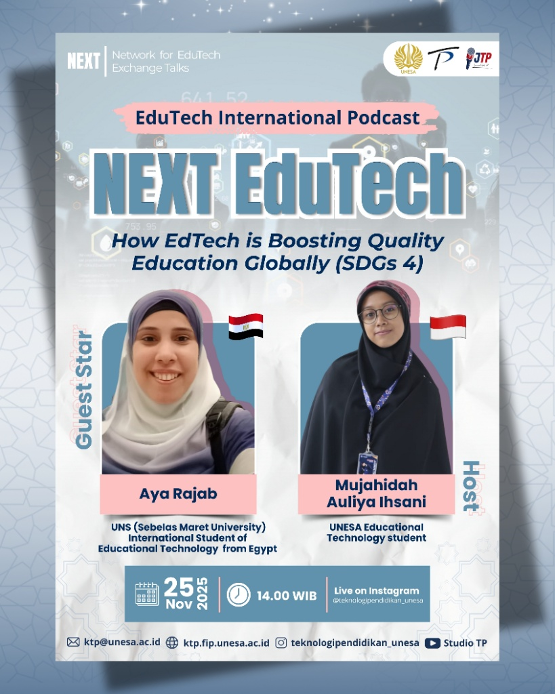
Surabaya, UNESA – The EduTech study program completed the second episode of its Network for EduTech Exchange Talks (NEXT) podcast on November 25, 2025. This international session zeroed in on the pivotal topic of how Educational Technology can elevate the quality of education worldwide, aligning perfectly with the fourth Sustainable Development Goal (SDG 4). Mujahidah Auliya Ihsani, a student in the UNESA Educational Technology program, hosted the broadcast. Aya Rajab, an international student from Egypt currently studying a Master's degree at Sebelas Maret University (UNS), provided a comparative analysis of the educational landscapes in both Egypt and Indonesia.
In this podcast, they discuss how educational technology can improve the quality of education in line with SDG 4. They also discuss how STEM has emerged as a potential solution to improve the quality of children's education. The discussion began with a critical look at the current educational challenges in Egypt. Aya Rajab noted that the widespread integration of technology remains rare. She explained that most schools still rely heavily on traditional, teacher-centered methodologies, such as lecture-based instruction. However, she highlighted the emergence of specialized STEM schools as a significant and fascinating departure from the norm. These institutions are different from ordinary schools. They prioritize a rigorous focus on STEM education and use technology more effectively to foster a modern, student-centered learning environment.
The dialogue unequivocally demonstrated the transformative power of EdTech, emphasizing how digital tools can be effectively utilized to guarantee that marginalized children receive an uninterrupted, top-tier education, even in the face of daunting systemic barriers. As the conversation unfolded, the speakers engaged in a fierce debate about the merits of emerging technologies, with a particular focus on whether Artificial Intelligence or gamification would deliver the most significant boost in teaching quality. They identified the potential of these tools and addressed the "biggest headaches"—such as infrastructure gaps and digital literacy—that often accompanied rapid digital adoption.
The podcast concluded with a visionary talk on the future of EdTech. The participants explored overlooked issues that they believed would become major points of contention in the next ten years, moving beyond current trends to predict the next shift in the pedagogical landscape. This second episode of the NEXT podcast reinforced the program's global network and provided students with a comprehensive view of enhancing education quality through EduTech for SDG 4. For those who missed the live session, the full recording is now available for viewing on the official Instagram account of the UNESA Educational Technology program.
Writer: Mujahidah Auliya Ihsani (2024B)
